
- Indigrators Solutions Pvt. Ltd. 3rd Floor, DHFLVC, Jayabheri Silicon Towers, Kondapur, Hitech City, Hyderabad – 500084, Telangana, India
- info@indigrators.com
- +91-9392932809


In today’s digital economy, Global Capability Centers (GCCs) are no longer just cost-efficient delivery hubs. They’ve evolved into strategic engines of innovation, operational excellence, and competitive advantage for global enterprises—especially mid-sized corporations seeking to scale beyond traditional boundaries. India, with its combination of talent density, cost-effective workforce, and rising innovation ecosystem, stands at the heart of this transformation.
Global Capability Centers—also known as Global In-House Centers or Captive Centers—are offshore units fully owned by parent organizations that deliver critical business functions such as IT, analytics, R&D, finance, HR, and product development. Historically, these centers focused on back-office functions and cost arbitrage. But the modern GCC has transformed into a multi-dimensional hub that supports innovation, drives technology adoption, and expands enterprise capabilities globally.
This strategic evolution amplifies value far beyond cost models—enabling faster market responsiveness, deeper customer insights, and scalable global operations.
India’s GCC ecosystem demonstrates both scale and sophistication. According to industry estimates, India hosts over 1,700 GCCs employing nearly 2 million professionals—a number projected to grow significantly by 2030.
Several forces fuel this growth:
1.Talent advantage: India’s deep pool of skilled professionals across technology, analytics, engineering, and domain specialties enables GCCs to shift from routine tasks to higher value creation.
2.Innovation ecosystem: Advanced research clusters, startups, and policy support have fostered an environment where GCCs can build and test new products, deploy AI/automation frameworks, and support global digital transformation.
3.Strategic differentiation: GCCs in India are now essential partners in enterprise digital strategy—driving key initiatives such as advanced analytics, cloud adoption, data engineering, and customer-centric solutions.
This evolution means that GCCs are no longer seen merely as cost centers—they are value creators, co-owners of enterprise digital roadmaps, and hubs for strategic transformation.
From the Inductus whitepaper and broader industry analysis, several trends emerge that are especially relevant for mid-market players:
While cost arbitrage remains attractive, the real competitive edge comes from capability building—connecting GCCs with core business outcomes such as speed-to-market, data-driven decision-making, and innovation cycles.
GCCs are embracing hybrid work models, flexible sourcing, and global digital collaboration—enabling companies to access diverse talent across geographies without compromising quality or agility.
GCCs are moving up the value chain to work on advanced functions such as R&D, AI integration, product engineering, and cloud modernization—activities once reserved for headquarters.
Government incentives, state-level policies, and ecosystem investments continue to strengthen GCC attractiveness—unlocking infrastructure advantages and reducing friction in setup and scaling.
Together, these trends underscore GCCs as transformational platforms—not just delivery centers.
For mid-sized enterprises that are navigating growth challenges, GCCs present a strategic blueprint to not only scale operations but also to future-proof business models. Here’s how:
1.Scalable innovation capacity: GCCs can centralize and accelerate experimentation with technology, helping mid-market players compete with larger peers.
2.Operational resilience: Distributed capabilities across geographies reduce single-point dependencies and reinforce continuity planning.
3.Talent leverage: Access to a broad talent pool allows integrators to balance cost, quality, and time-to-value.
4.Global integration: Connected GCCs act as bridges between global markets and local execution engines—driving faster delivery with contextual relevance.
In essence, GCCs empower mid-sized firms to operate with the sophistication and agility of larger global corporations.
The narrative around Global Capability Centers has shifted dramatically—from cost-saving outposts to strategic innovation hubs. India’s GCC ecosystem reflects this shift, offering capacity, capability, and a platform for growth that mid-sized companies can leverage effectively.
In a world where agility and innovation define success, GCCs are no longer an option—they are a strategic imperative for companies looking to scale with insight and resilience.
Source: India’s GCC Landscape: A Strategic Pathway for Mid-Sized Aspirational Corporations to Scale Beyond, Inductus GCC Whitepaper.
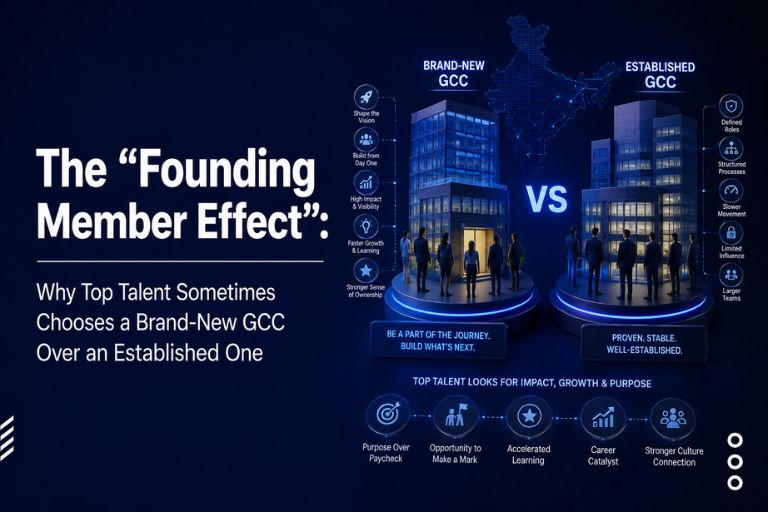
It looks, on paper, like an irrational decision: a strong candidate with offers from an established 3,000-person Bengaluru GCC and a brand-new, 12-person centre chooses the smaller one, at comparable pay. EY’s February 2026 report, “The India Capability Centres Employee Value Proposition Pulse,” gives this pattern a name — the “founding member effect” (EY, February 2026, p. 1) — and explains why it is not irrational at all once you understand what each type of centre is actually able to offer.
EY’s research frames it directly: newer GCCs pay a “risk premium” — a combination of early responsibility and the founding member effect — that appeals strongly to a specific segment of the modern workforce (EY, February 2026, p. 1). This is not a euphemism for “we can’t match the bigger company’s salary.” It describes something a large, mature GCC structurally cannot offer even if it wanted to: the chance to define a process rather than execute one someone else designed, direct and frequent access to leadership because there simply aren’t five layers of management in between, and visible, attributable ownership over outcomes in a team small enough that individual contribution is never lost in the noise.
EY’s report also connects this directly to innovation capacity at the ecosystem level: newer and nano GCCs are increasingly emerging as transformation hubs rather than service providers, precisely because the founding member effect draws in talent willing to build something rather than simply staff an existing operation (EY, February 2026, p. 3).
| Dimension | Established GCC | New / Nano GCC |
|---|---|---|
| What it sells | Trust, track record, global connectivity | Early responsibility, direct leadership access, "founding member effect" |
| Credibility source | Years of delivery history and brand recognition | Verifiable, real-time proof through the operating model |
| Best-fit candidate | Prefers structure, a defined ladder, and lower ambiguity | Optimises for ownership, growth speed, and influence over role definition |
| Biggest risk if mismanaged | EVP reads as generic and fails to differentiate | Founding-member pitch is promised but not operationally real |
| Natural expiry of the pitch | N/A — this is the steady-state pitch | Works for early hires; must transition to trust-based EVP as headcount scales |
The founding member pitch has a specific failure mode: it is trivially easy to promise and genuinely hard to deliver, and candidates evaluating early-stage GCCs are unusually good at detecting the gap between the two. EY’s broader framework — that autonomy, decision rights, and leadership access have to be proven through the operating model, not just claimed in a job posting (EY, February 2026, p. 1) — applies with extra force to a new centre, because a new centre has no track record to fall back on if the promise turns out to be hollow. If the “founding team” pitch is real, a candidate should be able to verify it within the interview process itself: Who do they report to, and how many layers separate that person from the actual decision-maker on their day-to-day work? Will they have input into how the team is structured as it grows, or is that already decided? Is there a specific, named piece of ambiguous work they will own, or is the “ownership” language describing tasks that are, in practice, already fully specified?
A GCC built through a phased or Build-Operate-Transfer model is, almost by definition, in founding-member territory during its early months — which is a genuine hiring advantage if it is used deliberately rather than treated as a temporary state to apologise for. The mistake some early-stage centres make is downplaying their newness, trying to sound more established than they are to seem more credible to candidates. EY’s data suggests the opposite approach performs better with the specific talent segment most valuable to a growing centre: lean into the founding-member framing explicitly, be honest about the stage the centre is at, and make the case that joining early is the opportunity, not a compromise made in the absence of a better offer.
The founding member effect works on a specific, identifiable segment of the talent market — people who are explicitly optimising for ownership, growth speed, and influence over a role’s definition, generally earlier-career or higher-risk-tolerance candidates. It does not substitute for competitive compensation, and EY’s research is explicit that risk-mitigating benefits still have to be part of the package (EY, February 2026, p. 1) — the founding member story is a complement to a solid offer, not a replacement for one. It also has a natural expiry date: the pitch that works for hire number three does not work for hire number three hundred, and centres need to consciously transition their EVP toward the trust-and-track-record framing that established GCCs use, well before the “founding team” language starts to sound dishonest to new candidates joining a centre that, by then, quietly has an org chart six layers deep.