
- Indigrators Solutions Pvt. Ltd. 3rd Floor, DHFLVC, Jayabheri Silicon Towers, Kondapur, Hitech City, Hyderabad – 500084, Telangana, India
- info@indigrators.com
- +91-9392932809


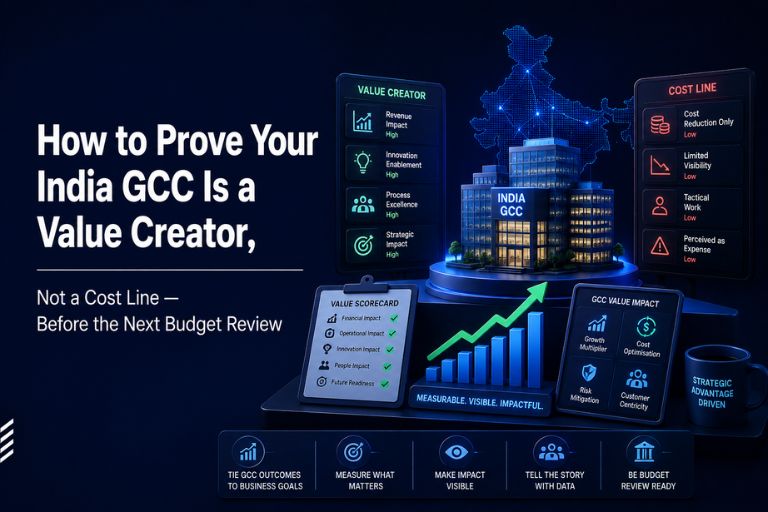
In today’s digital economy, Global Capability Centers (GCCs) are no longer just cost-efficient delivery hubs. They’ve evolved into strategic engines of innovation, operational excellence, and competitive advantage for global enterprises—especially mid-sized corporations seeking to scale beyond traditional boundaries. India, with its combination of talent density, cost-effective workforce, and rising innovation ecosystem, stands at the heart of this transformation.
Global Capability Centers—also known as Global In-House Centers or Captive Centers—are offshore units fully owned by parent organizations that deliver critical business functions such as IT, analytics, R&D, finance, HR, and product development. Historically, these centers focused on back-office functions and cost arbitrage. But the modern GCC has transformed into a multi-dimensional hub that supports innovation, drives technology adoption, and expands enterprise capabilities globally.
This strategic evolution amplifies value far beyond cost models—enabling faster market responsiveness, deeper customer insights, and scalable global operations.
India’s GCC ecosystem demonstrates both scale and sophistication. According to industry estimates, India hosts over 1,700 GCCs employing nearly 2 million professionals—a number projected to grow significantly by 2030.
Several forces fuel this growth:
1.Talent advantage: India’s deep pool of skilled professionals across technology, analytics, engineering, and domain specialties enables GCCs to shift from routine tasks to higher value creation.
2.Innovation ecosystem: Advanced research clusters, startups, and policy support have fostered an environment where GCCs can build and test new products, deploy AI/automation frameworks, and support global digital transformation.
3.Strategic differentiation: GCCs in India are now essential partners in enterprise digital strategy—driving key initiatives such as advanced analytics, cloud adoption, data engineering, and customer-centric solutions.
This evolution means that GCCs are no longer seen merely as cost centers—they are value creators, co-owners of enterprise digital roadmaps, and hubs for strategic transformation.
From the Inductus whitepaper and broader industry analysis, several trends emerge that are especially relevant for mid-market players:
While cost arbitrage remains attractive, the real competitive edge comes from capability building—connecting GCCs with core business outcomes such as speed-to-market, data-driven decision-making, and innovation cycles.
GCCs are embracing hybrid work models, flexible sourcing, and global digital collaboration—enabling companies to access diverse talent across geographies without compromising quality or agility.
GCCs are moving up the value chain to work on advanced functions such as R&D, AI integration, product engineering, and cloud modernization—activities once reserved for headquarters.
Government incentives, state-level policies, and ecosystem investments continue to strengthen GCC attractiveness—unlocking infrastructure advantages and reducing friction in setup and scaling.
Together, these trends underscore GCCs as transformational platforms—not just delivery centers.
For mid-sized enterprises that are navigating growth challenges, GCCs present a strategic blueprint to not only scale operations but also to future-proof business models. Here’s how:
1.Scalable innovation capacity: GCCs can centralize and accelerate experimentation with technology, helping mid-market players compete with larger peers.
2.Operational resilience: Distributed capabilities across geographies reduce single-point dependencies and reinforce continuity planning.
3.Talent leverage: Access to a broad talent pool allows integrators to balance cost, quality, and time-to-value.
4.Global integration: Connected GCCs act as bridges between global markets and local execution engines—driving faster delivery with contextual relevance.
In essence, GCCs empower mid-sized firms to operate with the sophistication and agility of larger global corporations.
The narrative around Global Capability Centers has shifted dramatically—from cost-saving outposts to strategic innovation hubs. India’s GCC ecosystem reflects this shift, offering capacity, capability, and a platform for growth that mid-sized companies can leverage effectively.
In a world where agility and innovation define success, GCCs are no longer an option—they are a strategic imperative for companies looking to scale with insight and resilience.
Source: India’s GCC Landscape: A Strategic Pathway for Mid-Sized Aspirational Corporations to Scale Beyond, Inductus GCC Whitepaper.
Every GCC eventually faces the same budget-review question, usually asked in a tone that assumes the answer is uncomfortable: “what is this centre actually worth to us, beyond the salary savings?” Most GCC leaders answer with activity metrics — tickets closed, uptime, headcount growth — because those are the numbers that are easiest to pull from existing dashboards. Those are the wrong metrics to lead with, and two independent 2026 research reports — Dun & Bradstreet’s “Decoding India’s GCC Ecosystem” and HFS Research’s “Turn Recurring GCC Work into Services-as-Software™” — offer concrete examples of what a better answer looks like.
GE’s John F. Welch Technology Centre in Bengaluru — the company’s largest integrated multidisciplinary R&D centre outside the US — houses over 5,000 engineers and has contributed more than 3,500 patents to GE’s global portfolio across aviation, healthcare, energy, and renewables (Dun & Bradstreet, 2026, p. 26). Hexagon runs its single largest global R&D site, 2,100 engineers, out of Hyderabad, supporting every product division in the company with a substantial software patent portfolio (Dun & Bradstreet, 2026, p. 25). AstraZeneca’s Chennai centre built, entirely in-house, a high-fidelity virtual reality replica of the company’s Swedish manufacturing facility — letting operators learn drug production processes without physically entering the plant, delivering measurable cost savings and zero material wastage during training (Dun & Bradstreet, 2026, p. 24). Lowe’s Bengaluru centre built a proprietary self-checkout system now handling 40–50% of in-store transactions across more than 1,700 US stores, built at a fraction of vendor cost with better stability than the commercial alternative it replaced (Dun & Bradstreet, 2026, p. 24).
HFS Research’s 2026 GCC case-studies suite — a sample of 174 case studies compiled in June 2026 — found that 62% of GCCs already run AI in production, not just in pilot (HFS Research, 2026, Exhibit 1, p. 2). Three examples from that suite show what value creation looks like inside recurring, non-glamorous operations rather than headline R&D: a global consumer goods company built a centralised digital capability that scales product development across functions and regions, delivering over 50 digital solutions on 12-to-16-week cycles, achieving more than a 30% cost reduction and up to 5% revenue growth (HFS Research, 2026, p. 2); a multinational bank consolidated shared services into reusable software, enabling 81 bots to handle 18,000 transactions a day, delivering USD 55 million in cost savings and improving key risk indicators by 80% (HFS Research, 2026, p. 3); and a global semiconductor leader built an agentic AI capability managing contract-based billing with 80% efficiency, saving 15,000 hours a year and resolving vendor queries twice as fast (HFS Research, 2026, p. 3).
| Company / Sector | What the GCC Built | Measurable Result |
|---|---|---|
| GE (aviation, healthcare, energy) | Largest integrated multidisciplinary R&D centre outside the US, Bengaluru | 5,000+ engineers; 3,500+ patents contributed to GE’s global portfolio |
| Hexagon (software/engineering) | Largest global R&D site, Hyderabad | 2,100 engineers supporting every product division |
| AstraZeneca (pharma) | In-house VR replica of a Swedish manufacturing facility, Chennai | Cost savings and zero material wastage during operator training |
| Lowe’s (retail) | Proprietary self-checkout system, Bengaluru | 40–50% of transactions handled (up from 25%); live in 1,700+ US stores |
| Global consumer goods company | Centralised digital product-development capability | 50+ digital solutions on 12–16-week cycles; 30%+ cost reduction; up to 5% revenue growth |
| Multinational bank | Reusable software for recurring transaction processing | 81 bots handling 18,000 transactions/day; USD 55 Mn saved; risk indicators improved 80% |
| Global semiconductor leader | Agentic AI capability for contract-based billing | 80% efficiency; 15,000 hours/year saved; vendor queries resolved 2x faster |
None of these are cost-avoidance stories. Each is a story about a capability that did not exist anywhere else in the company — patents, a training methodology, a checkout system, a reusable billing platform — and that happened to be built in India because that is where the team with the right combination of skills, ownership, and (increasingly) product discipline was located. That is the actual definition of a value-creating centre, and it points to the metrics framework worth adopting.
A centre far smaller than GE’s, Hexagon’s, or the HFS case studies above can still build a genuine value narrative using the same categories, scaled appropriately:
● IP and product contribution: Track features shipped, patents filed or contributed to, or process innovations the India team originated — not just delivered from a spec written elsewhere. A single feature the India team proposed and built end-to-end is a stronger data point than a hundred tickets closed on time.
● Cost avoidance beyond arbitrage: If the team automated a process, reduced vendor spend by building something in-house, or found a cheaper technical approach to an existing problem, quantify that separately from salary savings — it demonstrates judgement, not just lower cost per hour.
● Reuse and demand absorption: Following HFS Research’s framing (HFS Research, 2026, p. 3), track whether rising demand on a recurring process is being met through added headcount or through an expanding, reusable software asset. A team that absorbed a 40% volume increase without adding headcount has a materially stronger story than one that scaled linearly.
● Retention and institutional knowledge: A stable, low-attrition team retains context that a rotating outsourced vendor team cannot. This is harder to quantify but real — institutional knowledge compounds, and losing it resets the clock every time a key person leaves. Tenure and attrition rate, tracked over time, are a legitimate value metric, not just an HR metric.
The mistake most GCCs make is waiting until a budget review forces the question before assembling any of this evidence, at which point the honest answer is often “we don’t actually know, because we never tracked it that way.” The fix is straightforward but has to start early: define, at the point a function is handed to the India team, what “beyond execution” would look like for that specific function, and track it from the first quarter rather than reconstructing it retroactively. A centre that can walk into its second-year budget review with two or three concrete examples of capability it built — not just cost it avoided — has a fundamentally different negotiating position than one relying on a salary-arbitrage slide. The scale will be different from GE’s, Novartis’s, or HFS’s featured case studies. The category of evidence should not be.