
- Indigrators Solutions Pvt. Ltd. 3rd Floor, DHFLVC, Jayabheri Silicon Towers, Kondapur, Hitech City, Hyderabad – 500084, Telangana, India
- info@indigrators.com
- +91-9392932809


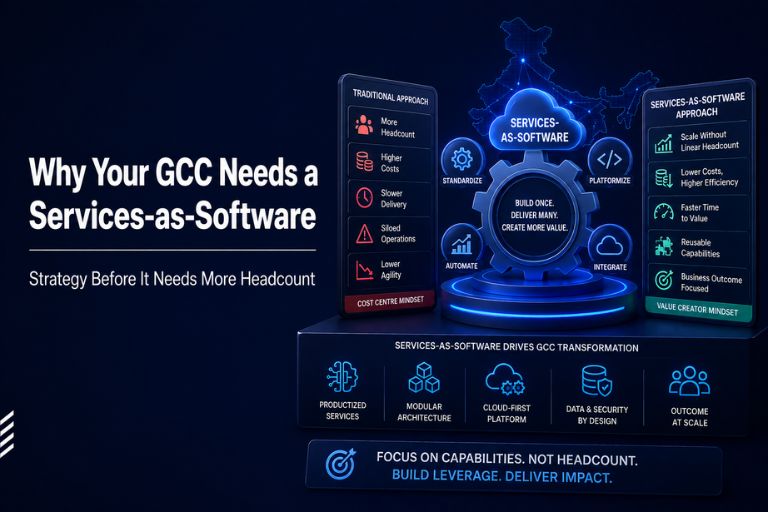
In today’s digital economy, Global Capability Centers (GCCs) are no longer just cost-efficient delivery hubs. They’ve evolved into strategic engines of innovation, operational excellence, and competitive advantage for global enterprises—especially mid-sized corporations seeking to scale beyond traditional boundaries. India, with its combination of talent density, cost-effective workforce, and rising innovation ecosystem, stands at the heart of this transformation.
Global Capability Centers—also known as Global In-House Centers or Captive Centers—are offshore units fully owned by parent organizations that deliver critical business functions such as IT, analytics, R&D, finance, HR, and product development. Historically, these centers focused on back-office functions and cost arbitrage. But the modern GCC has transformed into a multi-dimensional hub that supports innovation, drives technology adoption, and expands enterprise capabilities globally.
This strategic evolution amplifies value far beyond cost models—enabling faster market responsiveness, deeper customer insights, and scalable global operations.
India’s GCC ecosystem demonstrates both scale and sophistication. According to industry estimates, India hosts over 1,700 GCCs employing nearly 2 million professionals—a number projected to grow significantly by 2030.
Several forces fuel this growth:
1.Talent advantage: India’s deep pool of skilled professionals across technology, analytics, engineering, and domain specialties enables GCCs to shift from routine tasks to higher value creation.
2.Innovation ecosystem: Advanced research clusters, startups, and policy support have fostered an environment where GCCs can build and test new products, deploy AI/automation frameworks, and support global digital transformation.
3.Strategic differentiation: GCCs in India are now essential partners in enterprise digital strategy—driving key initiatives such as advanced analytics, cloud adoption, data engineering, and customer-centric solutions.
This evolution means that GCCs are no longer seen merely as cost centers—they are value creators, co-owners of enterprise digital roadmaps, and hubs for strategic transformation.
From the Inductus whitepaper and broader industry analysis, several trends emerge that are especially relevant for mid-market players:
While cost arbitrage remains attractive, the real competitive edge comes from capability building—connecting GCCs with core business outcomes such as speed-to-market, data-driven decision-making, and innovation cycles.
GCCs are embracing hybrid work models, flexible sourcing, and global digital collaboration—enabling companies to access diverse talent across geographies without compromising quality or agility.
GCCs are moving up the value chain to work on advanced functions such as R&D, AI integration, product engineering, and cloud modernization—activities once reserved for headquarters.
Government incentives, state-level policies, and ecosystem investments continue to strengthen GCC attractiveness—unlocking infrastructure advantages and reducing friction in setup and scaling.
Together, these trends underscore GCCs as transformational platforms—not just delivery centers.
For mid-sized enterprises that are navigating growth challenges, GCCs present a strategic blueprint to not only scale operations but also to future-proof business models. Here’s how:
1.Scalable innovation capacity: GCCs can centralize and accelerate experimentation with technology, helping mid-market players compete with larger peers.
2.Operational resilience: Distributed capabilities across geographies reduce single-point dependencies and reinforce continuity planning.
3.Talent leverage: Access to a broad talent pool allows integrators to balance cost, quality, and time-to-value.
4.Global integration: Connected GCCs act as bridges between global markets and local execution engines—driving faster delivery with contextual relevance.
In essence, GCCs empower mid-sized firms to operate with the sophistication and agility of larger global corporations.
The narrative around Global Capability Centers has shifted dramatically—from cost-saving outposts to strategic innovation hubs. India’s GCC ecosystem reflects this shift, offering capacity, capability, and a platform for growth that mid-sized companies can leverage effectively.
In a world where agility and innovation define success, GCCs are no longer an option—they are a strategic imperative for companies looking to scale with insight and resilience.
Source: India’s GCC Landscape: A Strategic Pathway for Mid-Sized Aspirational Corporations to Scale Beyond, Inductus GCC Whitepaper.
When demand on a GCC rises, the default response for twenty-five years has been the same: open more requisitions. HFS Research’s 2026 point of view, “Turn Recurring GCC Work into Services-as-Software™, Not Service Queues,” by Achyuta Ghosh and Srini Vaddepalli, argues that this default is now the wrong one for a large share of GCC work — and backs the argument with data from a genuinely large sample: 174 GCC case studies compiled in June 2026 (HFS Research, 2026, p. 2).
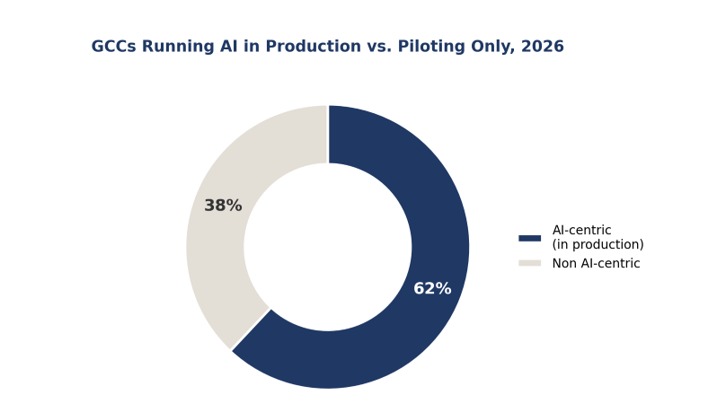
According to HFS’s case-studies suite, 62% of GCCs already use AI in production or embedded into operations, spanning generative AI, intelligent automation, machine learning, and a growing set of agentic AI deployments; only 38% remain non-AI-centric (HFS Research, 2026, Exhibit 1, p. 2). This matters because it moves the conversation past “should our GCC experiment with AI” — a majority already have, and the more urgent question for a GCC in 2026 is whether that AI use is scattered across isolated pilots or organised into what HFS calls a Services-as-Software model: repetitive work re-engineered into reusable workflows, data products, agentic services, and governed platforms (HFS Research, 2026, p. 1).
HFS’s report names three GCC transformations worth studying directly. A global consumer goods company built a centralised digital capability that scales product development across functions and regions, delivering over 50 digital solutions on 12-to-16-week cycles, achieving more than a 30% cost reduction and up to 5% revenue growth (HFS Research, 2026, p. 2). A multinational bank consolidated shared services processing thousands of recurring transactions — invoice processing, purchase order creation — into reusable software, enabling 81 bots to handle 18,000 transactions a day, delivering USD 55 million in cost savings while improving key risk indicators by 80% (HFS Research, 2026, p. 3). A global semiconductor leader created an agentic AI capability managing contract-based billing with 80% efficiency, saving 15,000 hours a year through automated accruals and resolving vendor queries twice as fast (HFS Research, 2026, p. 3).
HFS maps GCC execution models along a five-stage curve: staff augmentation (human-led delivery, limited structural change), technology-enabled services (human delivery augmented by proprietary tools, but value stays siloed), platform-led services (embedded platforms driving unified data, delivery, and control), AI-led agentic services (smart agents adapting tasks in real time and collaborating with humans), and Services-as-Software (services encoded and delivered primarily through software, with minimal human intervention) (HFS Research, 2026, Exhibit 2, p. 3). HFS is direct about the risk of staying at either of the first two stages: centres that remain in human-led delivery will struggle to scale reinvention, because a model dependent on people can add capacity but will typically struggle when the enterprise expects reuse, consistency, faster turnaround, and adaptability as conditions change (HFS Research, 2026, p. 1, 3).
| Stage | Design Characteristic | Outcome Characteristic |
|---|---|---|
| 1. Staff augmentation | Human-led delivery; limited change to operating model | Fills capacity gaps quickly; relies on scale; no structural transformation |
| 2. Technology-enabled services | Human delivery augmented by proprietary tools/accelerators | Enhances delivery, but value remains siloed with limited end-to-end visibility |
| 3. Platform-led services | Embedded platforms drive unified data, delivery, visibility, control | Improves consistency and scalability; foundation for AI augmentation |
| 4. AI-led agentic services | Smart agents adapt tasks in real time, collaborate with humans | AI augments human decisions; matured orchestration |
| 5. Services-as-Software™ | Services encoded and delivered primarily through software | Autonomous execution; maximum adaptability and speed |
HFS is explicit that enterprises do not need to productize every service at once (HFS Research, 2026, p. 4). The report proposes a simple two-axis matrix — business value against repeatability — to decide what to tackle first, summarised below.
| Quadrant | Definition | Example Activities |
|---|---|---|
| Productize into Services-as-Software (start here) | High value, high repeatability | Financial close and record-to-report; regulatory and compliance reporting; recurring customer/operations analytics; payments processing and reconciliation; KYC and AML checks |
| Keep expert-led | High value, low repeatability | Strategic FP&A and M&A analysis; complex cyber incident response and threat hunting; enterprise architecture and solution design; major audit and litigation support |
| Automate | Low value, high repeatability | Password resets and access provisioning; invoice data entry and matching; standard report generation and distribution; ticket routing and categorization |
| Eliminate or simplify | Low value, low repeatability | One-off manual data pulls; ad hoc spreadsheet reconciliations; duplicate or redundant status reporting |
HFS notes that established service providers are already packaging their own offerings as reusable software rather than bespoke, request-driven services: Infosys has productized its EdgeVerve AI platform and Topaz, Wipro is pushing software-led services through its Fusion proposition, and Genpact is transforming process expertise into agentic operations through AI Gigafactory and AI Maestro (HFS Research, 2026, p. 4). For a GCC leader, this is a useful signal independent of which vendor a company ultimately uses: the market itself has concluded that productized, reusable delivery is where GCC value is heading, not an optional add-on to a traditional staffing model.
HFS’s report notes that most GCCs already have the technology infrastructure needed to start; what they typically lack is true product ownership — a roadmap for reusable capability rather than a steady stream of project intake from internal “product owners” who are really just routing requests (HFS Research, 2026, p. 4). For a lean, newly built GCC, the practical starting point is smaller than it sounds: pick one recurring, rules-based, high-volume process already running in the centre, apply the HFS repeatability-and-value test to confirm it belongs in the “start here” quadrant, and fund it as a small reusable-capability project with its own owner — rather than folding it into general operations headcount. HFS’s own framing is the right closing test for any GCC leader deciding where to spend the next quarter’s investment: “the recurring problem on your desk today is the choice: productize with a Services-as-Software model, or staff it again next quarter” (HFS Research, 2026, “The Bottom Line,” p. 5).