
Beyond Headcount: Building Global Teams That Scale With Your Business
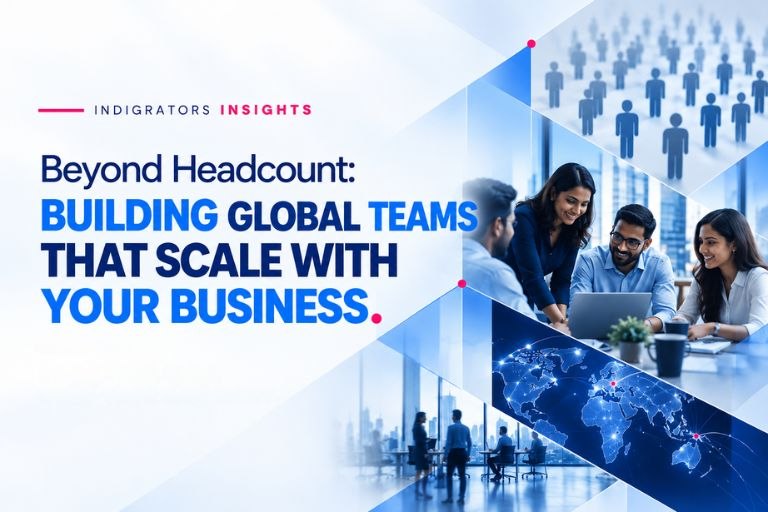
Why the next evolution of staff augmentation is about building high-performing India capabilities, not simply filling roles.
For years, staff augmentation has been a straightforward answer to a straightforward problem: we need more people. A product roadmap accelerates, a new technology enters the stack, a project needs specialized skills, or an organization needs to expand delivery capacity faster than conventional hiring allows. Bringing in external talent solves the immediate gap.
But the nature of that gap is changing. As technology cycles become shorter and businesses increasingly operate through distributed teams, the challenge is no longer simply finding additional people. It is building capabilities that can scale with the business — with the right expertise, operating model, integration, ownership, and flexibility.
This shift is particularly visible in India, where Global Capability Centers are moving rapidly from execution-oriented operations toward strategic business capabilities. According to the 2026 Zinnov-Nasscom GCC Landscape, India now has 2,117 GCCs across 3,728 units, employing 2.36 million professionals and generating $98.4 billion in revenue. The ecosystem has grown 32% since FY2021.
The message is clear: India is no longer simply a talent destination. It is becoming a platform for building global capability.
The Problem With Thinking in Headcount
Headcount is easy to measure. Capability is harder. Adding ten developers to a product organization does not automatically create the velocity of a ten-person team. The outcome depends on how quickly those people understand the product, integrate with existing teams, access the right systems, collaborate with stakeholders, and take ownership of meaningful work.
This becomes even more important as software engineering itself changes. Gartner predicts that 60% of organizations will adopt smaller software engineering teams at scale by 2029, compared with 15% in 2026. The shift is not simply about reducing team size; AI is taking on more routine technical work while engineers increasingly focus on complex problem-solving and innovation.
In that environment, the value of an external team cannot be measured by the number of people added. It has to be measured by the capability and outcomes those people enable.
That changes the question from:
“How many resources can you provide?”
to:
“What can this team own and deliver?”
From Staff Augmentation to Integrated Capability
The evolution is not about replacing staff augmentation. There will always be situations where organizations need flexible access to specialized talent.
The opportunity is to make that talent more integrated. A high-performing global team should understand the product it works on, operate within the client's technology environment, participate in established workflows, collaborate with internal stakeholders, and build knowledge that compounds over time.
That is where dedicated global teams become particularly powerful. Instead of treating external talent as a temporary layer around the organization, businesses can build teams that become an extension of their engineering, product, data, enterprise technology, or customer operations functions.
The distinction may appear subtle, but the business impact is significant. Staff augmentation adds capacity. Integrated teams build capability.
Why India Is Becoming Central to This Model
India's GCC ecosystem illustrates how quickly the definition of global capability is evolving.
The latest Zinnov-Nasscom research describes a structural shift from “Delivery Engine to Enterprise Nerve Centre.” GCCs are increasingly taking ownership of products, platforms, AI, innovation, and enterprise decision-making rather than operating solely as execution centers.
Deloitte's 2026 research points to a similar evolution in workforce strategy. In a survey of more than 500 global business and technology executives, 70% of organizations said they had brought previously outsourced work in-house during the last five years, while 67% reported adopting outcome-based outsourcing models. Deloitte's conclusion is not that organizations must choose between internal teams and external partners, but that they are increasingly combining GCCs, AI, and managed services to create more flexible operating models.
This creates a more nuanced opportunity for global businesses. They do not necessarily have to choose between “build internally” and “outsource.” They can build a strategic India capability while using the right external model to accelerate hiring, access specialized expertise, manage operations, and scale at the pace the business requires.
The New Equation: Talent + Integration + Operating Model
Talent remains the foundation. But talent alone does not create a scalable global team. Three elements increasingly matter.
1. The Right Capability
The team needs to be built around the actual business requirement — not a generic job description. That could mean product engineers, cloud specialists, data professionals, AI talent, enterprise application experts, customer support specialists, or a multidisciplinary team combining several capabilities.
2. Deep Integration
Teams need to operate within the business rather than around it. That means shared tools, processes, ceremonies, communication channels, product context, and accountability. The objective is to reduce the distance between the global organization and the India team.
3. A Scalable Operating Model
As teams grow, recruitment alone cannot solve the operational challenge. Organizations need governance, performance management, compliance, infrastructure, knowledge continuity, leadership, and processes that allow the team to scale without creating proportional complexity.
This is where the line between staff augmentation, dedicated teams, managed operations, and GCC models increasingly becomes fluid.
Building Capability Without Taking on Unnecessary Complexity
For many organizations, establishing a full GCC remains the right long-term strategy. But getting there can involve significant planning and execution — from the business case and location strategy to entity setup, compliance, talent acquisition, infrastructure, and ongoing operations.
Other businesses may need capability much sooner. A dedicated team or managed model can provide a bridge: access to specialized talent and operational support while the organization builds toward a larger India capability.
This flexibility matters because business needs rarely arrive in neat stages. A company may begin with five engineers, expand into a product engineering team, add customer support, establish enterprise technology capabilities, and eventually create its own GCC. The operating model needs to evolve with that journey.
What Global Businesses Should Ask Next
The future of global team building is unlikely to be defined by one model. Instead, successful organizations will combine GCCs, dedicated teams, managed operations, AI, and internal talent based on what each part of the business requires.
The better questions are therefore:
- What capabilities do we need to build?
- Where should those capabilities sit?
- How quickly do we need them?
- What should we own, and where can a partner accelerate execution?
- How do we scale without creating operational complexity?
These questions shift the conversation from procurement to strategy. And that is where the next generation of global teams will create their advantage.
Building What Comes Next
At Indigrators, this is the thinking behind our approach to dedicated global teams, GCCs, software development, enterprise solutions, customer support, and shared services.
The objective is not simply to provide people. It is to help global businesses build high-performing India capabilities that can integrate with the organization, scale with demand, and contribute to long-term business outcomes.
Because the future of staff augmentation is not about adding more headcount.
It is about turning talent into capability and capability into scale.
Ready to Build Your India Capability?
Explore how Indigrators helps global businesses build, operate, and scale high-performing India teams across technology, product, enterprise solutions, customer support, and GCC operations.
Build Your Global Team