
Transaction Hub, Knowledge Hub, Decision Center: Where Does Your India GCC Actually Stand?
In today’s digital economy, Global Capability Centers (GCCs) are no longer just cost-efficient delivery hubs. They’ve evolved into strategic engines of innovation, operational excellence, and competitive advantage for global enterprises—especially mid-sized corporations seeking to scale beyond traditional boundaries. India, with its combination of talent density, cost-effective workforce, and rising innovation ecosystem, stands at the heart of this transformation.
What Are GCCs and Why They Matter Today
Global Capability Centers—also known as Global In-House Centers or Captive Centers—are offshore units fully owned by parent organizations that deliver critical business functions such as IT, analytics, R&D, finance, HR, and product development. Historically, these centers focused on back-office functions and cost arbitrage. But the modern GCC has transformed into a multi-dimensional hub that supports innovation, drives technology adoption, and expands enterprise capabilities globally.
This strategic evolution amplifies value far beyond cost models—enabling faster market responsiveness, deeper customer insights, and scalable global operations.
India’s GCC Landscape: Growth, Depth, and Strategic Value
India’s GCC ecosystem demonstrates both scale and sophistication. According to industry estimates, India hosts over 1,700 GCCs employing nearly 2 million professionals—a number projected to grow significantly by 2030.
Several forces fuel this growth:
1.Talent advantage: India’s deep pool of skilled professionals across technology, analytics, engineering, and domain specialties enables GCCs to shift from routine tasks to higher value creation.
2.Innovation ecosystem: Advanced research clusters, startups, and policy support have fostered an environment where GCCs can build and test new products, deploy AI/automation frameworks, and support global digital transformation.
3.Strategic differentiation: GCCs in India are now essential partners in enterprise digital strategy—driving key initiatives such as advanced analytics, cloud adoption, data engineering, and customer-centric solutions.
This evolution means that GCCs are no longer seen merely as cost centers—they are value creators, co-owners of enterprise digital roadmaps, and hubs for strategic transformation.
Key GCC Trends Impacting Mid-Sized Corporations
From the Inductus whitepaper and broader industry analysis, several trends emerge that are especially relevant for mid-market players:
1. Strategic Shift From Cost to Capability
While cost arbitrage remains attractive, the real competitive edge comes from capability building—connecting GCCs with core business outcomes such as speed-to-market, data-driven decision-making, and innovation cycles.
2. Hybrid Talent and Digital Workforce Models
GCCs are embracing hybrid work models, flexible sourcing, and global digital collaboration—enabling companies to access diverse talent across geographies without compromising quality or agility.
3. Innovation-Led Value Delivery
GCCs are moving up the value chain to work on advanced functions such as R&D, AI integration, product engineering, and cloud modernization—activities once reserved for headquarters.
4. Policy and Ecosystem Support
Government incentives, state-level policies, and ecosystem investments continue to strengthen GCC attractiveness—unlocking infrastructure advantages and reducing friction in setup and scaling.
Together, these trends underscore GCCs as transformational platforms—not just delivery centers.
What This Means for Integrators and Mid-Sized Corporations
For mid-sized enterprises that are navigating growth challenges, GCCs present a strategic blueprint to not only scale operations but also to future-proof business models. Here’s how:
1.Scalable innovation capacity: GCCs can centralize and accelerate experimentation with technology, helping mid-market players compete with larger peers.
2.Operational resilience: Distributed capabilities across geographies reduce single-point dependencies and reinforce continuity planning.
3.Talent leverage: Access to a broad talent pool allows integrators to balance cost, quality, and time-to-value.
4.Global integration: Connected GCCs act as bridges between global markets and local execution engines—driving faster delivery with contextual relevance.
In essence, GCCs empower mid-sized firms to operate with the sophistication and agility of larger global corporations.
Conclusion: GCCs Are Core to Future Growth
The narrative around Global Capability Centers has shifted dramatically—from cost-saving outposts to strategic innovation hubs. India’s GCC ecosystem reflects this shift, offering capacity, capability, and a platform for growth that mid-sized companies can leverage effectively.
In a world where agility and innovation define success, GCCs are no longer an option—they are a strategic imperative for companies looking to scale with insight and resilience.
Source: India’s GCC Landscape: A Strategic Pathway for Mid-Sized Aspirational Corporations to Scale Beyond, Inductus GCC Whitepaper.
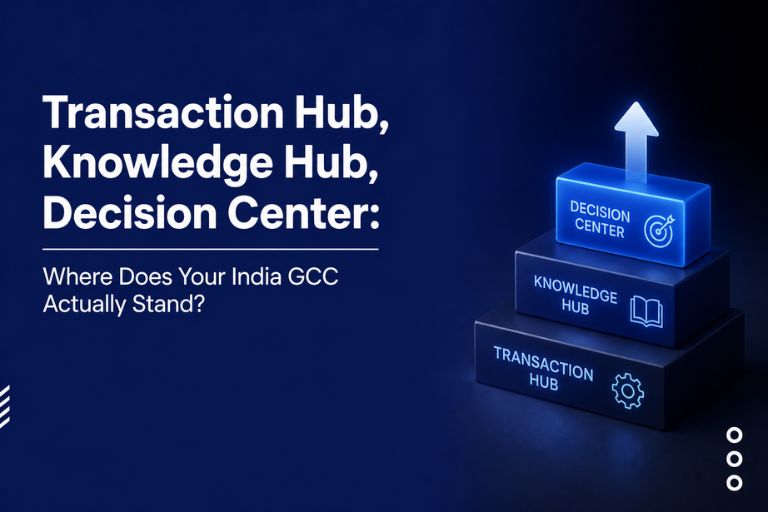
Ask ten GCC leaders where their India centre sits on the maturity curve and eight of them will describe it more optimistically than an outside auditor would. That gap matters, because the label attached to a centre — cost centre, capability hub, or decision centre — quietly determines its budget, its headcount ceiling, and how seriously headquarters takes its roadmap input. Dun & Bradstreet’s 2026 report, "Decoding India’s GCC Ecosystem – Bengaluru Edition," lays out a three-stage framework (credited in the report to Inductus Group) that is worth applying honestly to your own centre before your next budget review.
Stage one: the transaction hub (roughly the model through the 1990s and 2000s)
This is the classic offshore back office: high-volume, rule-based, low-complexity work, run for labour arbitrage and cost reduction. Processes are repetitive and standardised, decision-making is centralised at headquarters, and the centre exists to be efficient, not to be consulted. D&B’s framing is unambiguous about the economics here — cost profile low, value contribution low (Dun & Bradstreet, 2026, p. 34). Nothing wrong with that as a starting point; plenty of successful GCCs began exactly here. The mistake is staying there past the point where the talent market and the parent organisation both expect more.
Stage two: the knowledge hub (the 2010s shift)
The next stage is defined by expansion into domain-rich, knowledge-intensive functions: analytics, automation, engineering, and digital operations, with the centre taking real ownership of process outcomes rather than just executing tickets. D&B describes the profile as cost moderate, value contribution high (Dun & Bradstreet, 2026, p. 35) — the centre has stopped being purely a cost line and started building capability the parent organisation actually depends on. This is where most well-run mid-market GCCs sit today, and it is a perfectly stable place to operate from for years.
Stage three: the decision centre (what 2026 and beyond look like)
Old Framework (Pre-Reform)
- Subjective Margin Audits
- Unpredictable Transfer Tax
- Lengthy Dispute Timelines
VS
Updated Framework (Current)
- 15.5% Safe Harbour Norm
- Clear Value-Chain Status
- Streamlined 24-Month APA
The top of the curve is what D&B calls the decision centre: the GCC leads strategic initiatives rather than operational programmes, owns end-to-end products and platforms, anchors AI-first and cloud-native transformation, and has India-based leaders influencing or co-owning enterprise decisions rather than executing them (Dun & Bradstreet, 2026, p. 35). Cost profile is high; value contribution is described as critical. This is the model behind headline moves like GE’s Bengaluru centre contributing more than 3,500 patents to the company’s global portfolio, or Hexagon running its largest global R&D site — 2,100 engineers — out of Hyderabad (Dun & Bradstreet, 2026, p. 25–26). These are not back offices with a nicer name; they are functionally co-headquarters for specific product lines.
Table 1: The Three-Stage GCC Maturity Model
| Stage | Era | Focus | Cost Profile | Value Contribution |
|---|---|---|---|---|
| Transaction Hub | 1990s–2000s | Labour arbitrage; high-volume, rule-based, low-complexity work; centralised decisions at HQ | Low | Low |
| Knowledge Hub | 2010s | Domain expertise, analytics, automation, digital operations; real process ownership | Moderate | High |
| Decision Center | 2026 and beyond | Strategic leadership, end-to-end product ownership, AI-first transformation, India-based decision rights | High | Critical |
A fourth lens: HFS Research’s execution-model view of the same curve
HFS Research’s 2026 point of view, "Turn Recurring GCC Work into Services-as-Software™, Not Service Queues," maps a closely related but distinct progression — not maturity of mandate, but maturity of execution model. HFS describes five stages: staff augmentation (human-led delivery, limited change to the operating model), technology-enabled services (human delivery augmented by tools), platform-led services (embedded platforms driving unified data and delivery), AI-led agentic services (smart agents adapting tasks in real time alongside humans), and finally Services-as-Software (services encoded and delivered primarily through software, with minimal human intervention) (HFS Research, 2026, Exhibit 2, p. 3). The useful insight for a GCC leader is that these two maturity models are not competing frameworks — they describe the same evolution from two angles. A centre cannot credibly claim decision-centre status under D&B’s model while still running every recurring process through staff augmentation under HFS’s model. Strategic maturity and execution maturity have to advance together.
Table 2: HFS Research’s Five-Stage GCC Execution Model
| Execution Stage | Design Characteristic | Outcome Characteristic |
|---|---|---|
| 1. Staff augmentation | Human-led delivery; limited change to operating model | Fills capacity gaps quickly; no structural transformation; relies on scale |
| 2. Technology-enabled services | Human delivery augmented by proprietary tools or accelerators | Enhances delivery with tools; value remains siloed; lacks end-to-end visibility |
| 3. Platform-led services | Embedded platforms drive unified data, delivery, visibility, and control | Improves consistency and scalability; enables cross-function orchestration |
| 4. AI-led agentic services | Smart agents adapt tasks in real time and collaborate with humans | AI augments human decisions and execution; matured orchestration |
| 5. Services-as-Software™ | Services encoded and delivered primarily through software; minimal human intervention | Autonomous execution; maximum adaptability and speed |
A quick, honest self-diagnostic
Three questions tend to reveal the real stage faster than any internal scorecard:
● Who decides what the India team works on next quarter — does headquarters hand down a fixed backlog, or does the India leadership team propose the roadmap? (Transaction hub vs. knowledge hub or higher.)
● If the India centre disappeared tomorrow, would the parent company lose capacity, or would it lose capability it cannot easily rebuild elsewhere? (Knowledge hub vs. decision centre.)
● When demand rises on a recurring process, does the response default to hiring more people, or to expanding a reusable, software-encoded capability? (HFS Research, 2026, p. 3 — the clearest tell of execution-model maturity.)
Why this matters more for mid-market companies than it seems
It is tempting to read the maturity model as a story about giants like GE, Novartis, and Hexagon, and conclude it does not apply to a 400-person parent company setting up its first 15-person India team. The opposite is closer to true. A mid-market company does not have the luxury of running a large, low-value transaction hub for a decade while it figures out what India is for — the economics do not support it, and the EY EVP data covered elsewhere in this series shows that top talent is actively avoiding centres that read as pure cost plays. The realistic path for a lean GCC is to skip the extended transaction-hub phase almost entirely: start in knowledge-hub territory from month one, with a small team doing real, ownership-bearing work, and build deliberately toward decision-centre characteristics — India-based decision rights, a direct line into the product roadmap, and reusable rather than headcount-dependent delivery — well before headcount scale would traditionally justify it.
What this looks like in a BOT-based setup
A Build-Operate-Transfer model is, in effect, a structured way to compress this maturity curve. The "build" and "operate" phases handle the mechanics that would otherwise keep a company stuck at transaction-hub economics — entity setup, compliance, HR infrastructure, office and IT — while the client’s own leadership focuses from day one on what a knowledge-hub or decision-centre team actually needs: clear ownership boundaries, a real seat in planning conversations, and hiring that targets capability rather than headcount. The "transfer" phase then hands over a centre that was designed for maturity from the start, rather than one that has to be re-architected five years in once someone in the boardroom asks why the India team still just executes tickets.
Ready to build your India team?
Talk to us about GCC setup, software development, or talent solutions.
Get in Touch