
Why a $241 Billion Sector Should Change How Mid-Market CFOs Think About India

In today’s digital economy, Global Capability Centers (GCCs) are no longer just cost-efficient delivery hubs. They’ve evolved into strategic engines of innovation, operational excellence, and competitive advantage for global enterprises—especially mid-sized corporations seeking to scale beyond traditional boundaries. India, with its combination of talent density, cost-effective workforce, and rising innovation ecosystem, stands at the heart of this transformation.
What Are GCCs and Why They Matter Today
Global Capability Centers—also known as Global In-House Centers or Captive Centers—are offshore units fully owned by parent organizations that deliver critical business functions such as IT, analytics, R&D, finance, HR, and product development. Historically, these centers focused on back-office functions and cost arbitrage. But the modern GCC has transformed into a multi-dimensional hub that supports innovation, drives technology adoption, and expands enterprise capabilities globally.
This strategic evolution amplifies value far beyond cost models—enabling faster market responsiveness, deeper customer insights, and scalable global operations.
India’s GCC Landscape: Growth, Depth, and Strategic Value
India’s GCC ecosystem demonstrates both scale and sophistication. According to industry estimates, India hosts over 1,700 GCCs employing nearly 2 million professionals—a number projected to grow significantly by 2030.
Several forces fuel this growth:
1.Talent advantage: India’s deep pool of skilled professionals across technology, analytics, engineering, and domain specialties enables GCCs to shift from routine tasks to higher value creation.
2.Innovation ecosystem: Advanced research clusters, startups, and policy support have fostered an environment where GCCs can build and test new products, deploy AI/automation frameworks, and support global digital transformation.
3.Strategic differentiation: GCCs in India are now essential partners in enterprise digital strategy—driving key initiatives such as advanced analytics, cloud adoption, data engineering, and customer-centric solutions.
This evolution means that GCCs are no longer seen merely as cost centers—they are value creators, co-owners of enterprise digital roadmaps, and hubs for strategic transformation.
Key GCC Trends Impacting Mid-Sized Corporations
From the Inductus whitepaper and broader industry analysis, several trends emerge that are especially relevant for mid-market players:
1. Strategic Shift From Cost to Capability
While cost arbitrage remains attractive, the real competitive edge comes from capability building—connecting GCCs with core business outcomes such as speed-to-market, data-driven decision-making, and innovation cycles.
2. Hybrid Talent and Digital Workforce Models
GCCs are embracing hybrid work models, flexible sourcing, and global digital collaboration—enabling companies to access diverse talent across geographies without compromising quality or agility.
3. Innovation-Led Value Delivery
GCCs are moving up the value chain to work on advanced functions such as R&D, AI integration, product engineering, and cloud modernization—activities once reserved for headquarters.
4. Policy and Ecosystem Support
Government incentives, state-level policies, and ecosystem investments continue to strengthen GCC attractiveness—unlocking infrastructure advantages and reducing friction in setup and scaling.
Together, these trends underscore GCCs as transformational platforms—not just delivery centers.
What This Means for Integrators and Mid-Sized Corporations
For mid-sized enterprises that are navigating growth challenges, GCCs present a strategic blueprint to not only scale operations but also to future-proof business models. Here’s how:
1.Scalable innovation capacity: GCCs can centralize and accelerate experimentation with technology, helping mid-market players compete with larger peers.
2.Operational resilience: Distributed capabilities across geographies reduce single-point dependencies and reinforce continuity planning.
3.Talent leverage: Access to a broad talent pool allows integrators to balance cost, quality, and time-to-value.
4.Global integration: Connected GCCs act as bridges between global markets and local execution engines—driving faster delivery with contextual relevance.
In essence, GCCs empower mid-sized firms to operate with the sophistication and agility of larger global corporations.
Conclusion: GCCs Are Core to Future Growth
The narrative around Global Capability Centers has shifted dramatically—from cost-saving outposts to strategic innovation hubs. India’s GCC ecosystem reflects this shift, offering capacity, capability, and a platform for growth that mid-sized companies can leverage effectively.
In a world where agility and innovation define success, GCCs are no longer an option—they are a strategic imperative for companies looking to scale with insight and resilience.
Source: India’s GCC Landscape: A Strategic Pathway for Mid-Sized Aspirational Corporations to Scale Beyond, Inductus GCC Whitepaper.
Most mid-market executives evaluating a first India centre are still running the math as if it is 2015: compare an Indian salary to a US or European one, apply a discount, decide whether the savings justify the hassle. That math was never wrong, exactly, but it badly understates what is actually available today. Dun & Bradstreet’s 2026 sizing of India’s GCC sector — published in "Decoding India’s GCC Ecosystem – Bengaluru Edition" — puts total economic output at an estimated USD 241 billion in FY25 (Dun & Bradstreet, 2026, p. 18), and the more useful number for a CFO is not the total, but what it implies about the maturity of the ecosystem a new centre is plugging into.
The headline numbers, and why the trend line matters more than the level
Direct output from GCCs reached an estimated USD 76 billion in FY25, more than six times the roughly USD 12 billion recorded in 2010 — a 13% compound annual growth rate sustained across fifteen years, not a single good year (Dun & Bradstreet, 2026, p. 18–19). D&B projects direct output nearly doubling again to USD 143 billion by 2030 (Dun & Bradstreet, 2026, p. 19). Gross Value Added came in at an estimated USD 182 billion, with the direct portion alone (USD 68 billion) equivalent to roughly 2% of India’s entire GDP and 4% of its services-sector GDP (Dun & Bradstreet, 2026, p. 20). Employment across direct, allied, and induced categories reached an estimated 10.4 million, of which 2.1 million are direct GCC employees (Dun & Bradstreet, 2026, p. 22).
Fifteen Years of GCC Growth Is a Trend, Not a Cycle
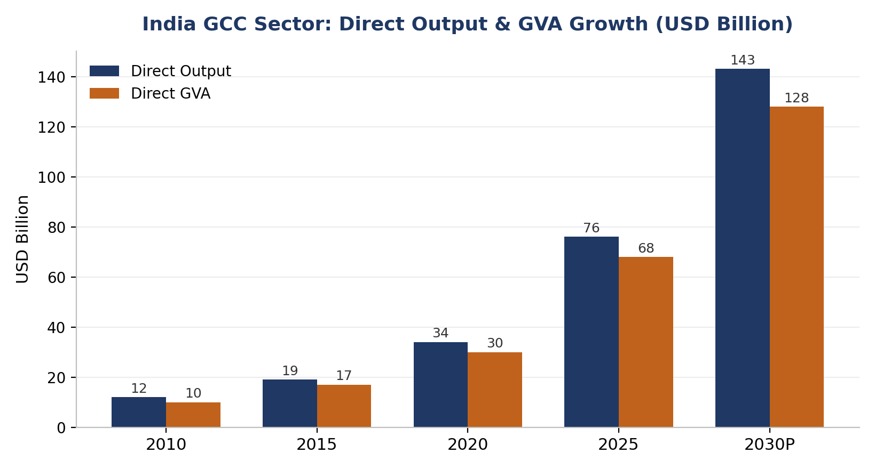
| Metric | 2010 | FY25 (Current) | 2030 (Projected) |
|---|---|---|---|
| Direct Output (USD Bn) | 12 | 76 | 143 |
| Direct GVA (USD Bn) | 10 | 68 | 128 |
| Total Economic Output, all channels (USD Bn) | n/a | 241 | n/a |
| Net Exports (USD Bn) | 9 | 62 | 116 |
| Number of GCCs | n/a | ~1,800 (2025) | ~2,400+ |
| Direct Employment | n/a | 2.1 million | n/a |
What this actually tells a company that has never hired in India before
A sector this size is not a cost-arbitrage niche anymore; it is core infrastructure. That has three concrete, practical implications for a first-time entrant:
● The vendor and partner ecosystem is deep and specialised. Legal entity formation, payroll compliance, commercial real estate for GCCs, and BOT-style setup partners are now established categories with track records — not a market you have to figure out from scratch with generalist consultants.
● The talent market has priced in GCC-grade productivity. D&B calculates GVA per direct employee at approximately USD 32,500 — more than eleven times India’s national GVA per capita and broadly comparable to per-capita output in Japan and South Korea (Dun & Bradstreet, 2026, p. 23). That is a direct signal that the "India = cheap" framing understates what a well-run centre actually produces per person; the honest comparison is value per employee, not cost per hour.
● Government policy has caught up with demand. Multiple states now run dedicated GCC policies with real incentives — covered in more detail elsewhere in this series — rather than treating GCCs as a subset of generic IT/ITeS policy.
The export and forex angle most companies never think about
Old Framework (Pre-Reform)
- Subjective Margin Audits
- Unpredictable Transfer Tax
- Lengthy Dispute Timelines
VS
Updated Framework (Current)
- 15.5% Safe Harbour Norm
- Clear Value-Chain Status
- Streamlined 24-Month APA
One figure that rarely comes up in vendor pitches but matters for anyone thinking about currency exposure: GCC exports reached an estimated USD 62 billion in FY25, equivalent to roughly 9% of India’s total forex reserves, with near-zero import dependence because GCC output does not require imported inputs the way manufacturing exports do (Dun & Bradstreet, 2026, p. 21). That matters less for an individual company’s decision and more as a signal of how structurally embedded the sector now is in Indian macroeconomic policy — this is not a sector any future government has an incentive to destabilise.
Where mid-market companies fit into a market this size
The scale numbers understandably read as a story about the world’s largest enterprises — the GEs, Novartis, and JPMorgans of the GCC world. But D&B’s own growth projections — GCC count rising from roughly 1,800 in 2025 to over 2,400 by 2030 (Dun & Bradstreet, 2026, p. 7, 16) — cannot be explained by large-enterprise expansion alone; there are only so many Fortune 500 companies left without an India centre. A meaningful share of that projected growth has to come from mid-sized companies — the SaaS scale-ups, specialty manufacturers, and regional financial services firms that a decade ago would have defaulted to a third-party outsourcing arrangement instead. The infrastructure, talent depth, and policy support that used to be available only to companies large enough to run a 500-person captive centre are now accessible to a company building a 20-person team through a phased or BOT-based model.
The practical takeaway
A CFO evaluating an India centre in 2026 is not making a bet on an emerging, unproven market. The bet was already validated by USD 241 billion in economic activity and a fifteen-year growth trend that survived multiple global downturns (Dun & Bradstreet, 2026, p. 18). What is left to decide is not whether India works as a GCC destination — that question is settled — but which entry model, which city, and which functions to start with. That is a much narrower, much more answerable question, and it is the one worth spending diligence time on.
Ready to build your India team?
Talk to us about GCC setup, software development, or talent solutions.
Get in Touch