
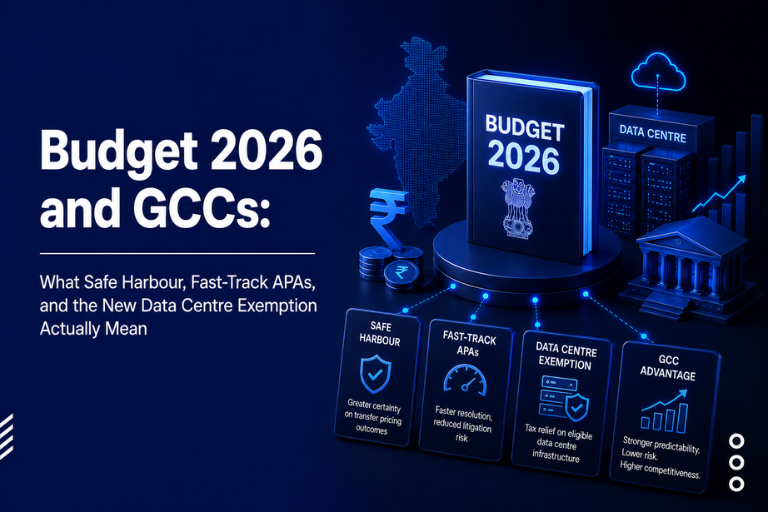
Budget 2026 and GCCs: What Safe Harbour, Fast-Track APAs, and the New Data Centre Exemption Actually Mean
In today’s digital economy, Global Capability Centers (GCCs) are no longer just cost-efficient delivery hubs. They’ve evolved into strategic engines of innovation, operational excellence, and competitive advantage for global enterprises—especially mid-sized corporations seeking to scale beyond traditional boundaries. India, with its combination of talent density, cost-effective workforce, and rising innovation ecosystem, stands at the heart of this transformation.
What Are GCCs and Why They Matter Today
Global Capability Centers—also known as Global In-House Centers or Captive Centers—are offshore units fully owned by parent organizations that deliver critical business functions such as IT, analytics, R&D, finance, HR, and product development. Historically, these centers focused on back-office functions and cost arbitrage. But the modern GCC has transformed into a multi-dimensional hub that supports innovation, drives technology adoption, and expands enterprise capabilities globally.
This strategic evolution amplifies value far beyond cost models—enabling faster market responsiveness, deeper customer insights, and scalable global operations.
India’s GCC Landscape: Growth, Depth, and Strategic Value
India’s GCC ecosystem demonstrates both scale and sophistication. According to industry estimates, India hosts over 1,700 GCCs employing nearly 2 million professionals—a number projected to grow significantly by 2030.
Several forces fuel this growth:
1.Talent advantage: India’s deep pool of skilled professionals across technology, analytics, engineering, and domain specialties enables GCCs to shift from routine tasks to higher value creation.
2.Innovation ecosystem: Advanced research clusters, startups, and policy support have fostered an environment where GCCs can build and test new products, deploy AI/automation frameworks, and support global digital transformation.
3.Strategic differentiation: GCCs in India are now essential partners in enterprise digital strategy—driving key initiatives such as advanced analytics, cloud adoption, data engineering, and customer-centric solutions.
This evolution means that GCCs are no longer seen merely as cost centers—they are value creators, co-owners of enterprise digital roadmaps, and hubs for strategic transformation.
Key GCC Trends Impacting Mid-Sized Corporations
From the Inductus whitepaper and broader industry analysis, several trends emerge that are especially relevant for mid-market players:
1. Strategic Shift From Cost to Capability
While cost arbitrage remains attractive, the real competitive edge comes from capability building—connecting GCCs with core business outcomes such as speed-to-market, data-driven decision-making, and innovation cycles.
2. Hybrid Talent and Digital Workforce Models
GCCs are embracing hybrid work models, flexible sourcing, and global digital collaboration—enabling companies to access diverse talent across geographies without compromising quality or agility.
3. Innovation-Led Value Delivery
GCCs are moving up the value chain to work on advanced functions such as R&D, AI integration, product engineering, and cloud modernization—activities once reserved for headquarters.
4. Policy and Ecosystem Support
Government incentives, state-level policies, and ecosystem investments continue to strengthen GCC attractiveness—unlocking infrastructure advantages and reducing friction in setup and scaling.
Together, these trends underscore GCCs as transformational platforms—not just delivery centers.
What This Means for Integrators and Mid-Sized Corporations
For mid-sized enterprises that are navigating growth challenges, GCCs present a strategic blueprint to not only scale operations but also to future-proof business models. Here’s how:
1.Scalable innovation capacity: GCCs can centralize and accelerate experimentation with technology, helping mid-market players compete with larger peers.
2.Operational resilience: Distributed capabilities across geographies reduce single-point dependencies and reinforce continuity planning.
3.Talent leverage: Access to a broad talent pool allows integrators to balance cost, quality, and time-to-value.
4.Global integration: Connected GCCs act as bridges between global markets and local execution engines—driving faster delivery with contextual relevance.
In essence, GCCs empower mid-sized firms to operate with the sophistication and agility of larger global corporations.
Conclusion: GCCs Are Core to Future Growth
The narrative around Global Capability Centers has shifted dramatically—from cost-saving outposts to strategic innovation hubs. India’s GCC ecosystem reflects this shift, offering capacity, capability, and a platform for growth that mid-sized companies can leverage effectively.
In a world where agility and innovation define success, GCCs are no longer an option—they are a strategic imperative for companies looking to scale with insight and resilience.
Source: India’s GCC Landscape: A Strategic Pathway for Mid-Sized Aspirational Corporations to Scale Beyond, Inductus GCC Whitepaper.
Tax certainty is one of the quieter reasons companies delay or abandon GCC plans — not because the eventual tax bill is unmanageable, but because the multi-year uncertainty around transfer pricing scrutiny makes financial planning difficult. Budget 2026 addressed this directly for GCCs, and the changes — detailed by Aditya Hans, Partner at Dhruva Advisors India Private Limited, in Dun & Bradstreet’s 2026 report "Decoding India’s GCC Ecosystem – Bengaluru Edition" — are specific enough to be worth understanding in plain language rather than through a generic "India improved its tax regime" summary.
What changed in the Safe Harbour Regime
Historically, GCCs setting transfer pricing mark-ups faced a fragmented set of prescribed rates ranging between 17% and 24% depending on whether the work was classified as IT, ITeS, KPO, or contract R&D — a distinction that generated real disputes about how to classify hybrid or evolving functions (Dhruva Advisors’ Aditya Hans, in Dun & Bradstreet, 2026, p. 29). Budget 2026 consolidates all four categories into a single "IT Services" bucket with one uniform 15.5% mark-up (Dun & Bradstreet, 2026, p. 29). For a mid-size GCC, this does two things at once: it lowers the effective mark-up from the upper end of the old range, and it removes an entire category of dispute (arguing over classification) that used to consume advisory time and create audit risk.
The turnover threshold to access this simplified regime was also raised, to INR 20,000 million (approximately USD 213 million) (Dun & Bradstreet, 2026, p. 29). That threshold increase is the detail most relevant to companies in the mid-market range this content set is written for — it brings meaningfully more growing GCCs into a regime that previously was, in practice, mainly available to larger centres.
What changed for larger GCCs above the threshold
For centres with turnover above INR 20,000 million, Budget 2026 introduces a fast-track unilateral Advance Pricing Agreement (APA) process for IT/ITeS services, targeting a 2-year resolution timeline against a process that previously could run as long as 5 years (Dun & Bradstreet, 2026, p. 29). An APA is, in effect, a negotiated agreement with tax authorities on the transfer pricing methodology in advance, rather than defending a position after the fact during an audit. Cutting that process from five years to a targeted two years materially changes how far in advance a finance team can plan with confidence — and mid-size GCCs approaching the threshold can also explore APAs as a route to a mark-up lower than the standard 15.5%, rather than defaulting to the Safe Harbour rate (Dun & Bradstreet, 2026, p. 29).
The new data centre exemption, and why it matters beyond data centre operators
A less obvious but potentially significant change: Budget 2026 introduces a long-term tax exemption, running until 2047, for foreign companies procuring data centre services from specified Indian data centres (Dun & Bradstreet, 2026, p. 29). Foreign companies can now establish wholly owned subsidiaries in India for data centre management and qualify for a Safe Harbour mark-up of 15%, which makes India-based data centre operations considerably more financially viable than before (Dun & Bradstreet, 2026, p. 29). For a GCC — particularly one in a data-intensive function like analytics, AI/ML, or cloud engineering — this matters because it strengthens the underlying infrastructure and data-sovereignty case for keeping compute and storage in-country rather than routing everything through offshore infrastructure, which has knock-on implications for both cost and the data-localisation compliance conversation covered in GCC cybersecurity and governance frameworks generally
Budget 2026 GCC Tax Provisions — Before and After
| Provision | Before Budget 2026 | After Budget 2026 |
|---|---|---|
| Safe Harbour classification | Separate IT, ITeS, KPO, and contract R&D categories, each with its own rate | Consolidated into a single "IT Services" category |
| Safe Harbour mark-up | 17%–24% depending on classification, with disputes over which category applied | Uniform 15.5% mark-up |
| Safe Harbour turnover threshold | Lower ceiling, effectively favouring larger GCCs | Raised to INR 20,000 million (~USD 213 Mn) |
| APA process (above threshold) | Standard process, up to 5 years to resolve | Fast-track unilateral APA, targeted 2-year resolution |
| Data centre services (foreign companies) | No dedicated long-term exemption; standard tax treatment | Exemption through 2047 for procurement from specified Indian data centres; 15% Safe Harbour mark-up for India-based data centre subsidiaries |
Old Framework (Pre-Reform)
- Subjective Margin Audits
- Unpredictable Transfer Tax
- Lengthy Dispute Timelines
VS
Updated Framework (Current)
- 15.5% Safe Harbour Norm
- Clear Value-Chain Status
- Streamlined 24-Month APA
What this changes in practical planning terms
None of these changes eliminate the need for proper transfer pricing documentation or professional tax advisory — they reduce uncertainty and cost, they do not remove the requirement to comply correctly. The practical shift for a company planning a GCC in 2026 is that the transfer pricing conversation, which used to be a genuine source of multi-year planning risk, is now a much more solvable, bounded question: know your projected turnover against the INR 20,000 million threshold, know whether Safe Harbour at 15.5% or a negotiated APA is the better fit for your structure, and factor the data centre exemption into any decision about where compute-heavy workloads sit. These are questions with concrete, current answers rather than open-ended risk factors — which is precisely what a five-year GCC business case needs.
A caveat worth stating plainly
Tax policy interpretation is genuinely specialised, and turnover thresholds, mark-up rates, and eligibility criteria are exactly the kind of detail that benefits from a qualified tax advisor reviewing the specific facts of a company’s structure before any number goes into a board presentation. This article summarises Dhruva Advisors’ published commentary in Dun & Bradstreet’s 2026 report; it is a map of what changed, not a substitute for that review — pair it with your own tax counsel and, ideally, a GCC advisory partner who has already run current-year Safe Harbour applications for centres in your revenue range.
Ready to build your India team?
Talk to us about GCC setup, software development, or talent solutions.
Get in Touch