
From Cost Centers to Growth Engines: The New Metrics Defining GCC Success
For nearly three decades, Global Capability Centres (GCCs) were evaluated through a narrow operational lens. Success was measured by how many employees a center hired, how much operational expenditure it reduced, and how efficiently it executed predefined business processes. These metrics made sense when GCCs primarily functioned as offshore delivery organizations supporting headquarters through labor arbitrage and transactional execution. That reality has fundamentally changed.
Today's GCCs are responsible for designing enterprise AI platforms, leading global engineering initiatives, developing intellectual property, managing cybersecurity operations, and driving digital transformation programs that directly influence competitive advantage. Their contribution extends well beyond operational efficiency, they increasingly shape business strategy, accelerate innovation, and generate measurable enterprise value.
As organizations continue to expand their India footprint, one question is becoming increasingly important for boards and executive leadership teams:
Are we still measuring our GCC using yesterday's metrics? According to PwC India's latest analysis on the evolution of Global Capability Centres, value creation has overtaken cost optimization as the defining measure of success. Enterprises are shifting their focus toward innovation outcomes, product ownership, customer impact, and business growth rather than simply tracking operational expenditure. This shift represents one of the most significant changes in how global organizations evaluate their investments in India.
Why Traditional GCC Metrics No Longer Work
Legacy performance metrics were designed for a fundamentally different operating model. Organizations focused on headcount expansion, service-level agreements, utilization rates, and annual cost savings because GCCs were primarily expected to execute processes designed elsewhere.
However, modern GCCs no longer operate at the end of the value chain. They increasingly own entire product portfolios, AI initiatives, cloud platforms, and enterprise-wide digital capabilities.
Measuring these organizations solely by operational efficiency creates a dangerous disconnect between the work being performed and the value being recognized.
A center that develops an AI-powered customer platform capable of increasing global revenue cannot be evaluated using the same framework as one processing finance transactions. Similarly, a team responsible for launching new digital products contributes far more than payroll savings they directly influence market competitiveness and customer experience.
As GCCs transition from execution centers to innovation hubs, their performance framework must evolve accordingly.
From Operational KPIs to Business Outcomes
The highest-performing organizations are replacing activity-based metrics with business-oriented performance indicators that reflect strategic impact.
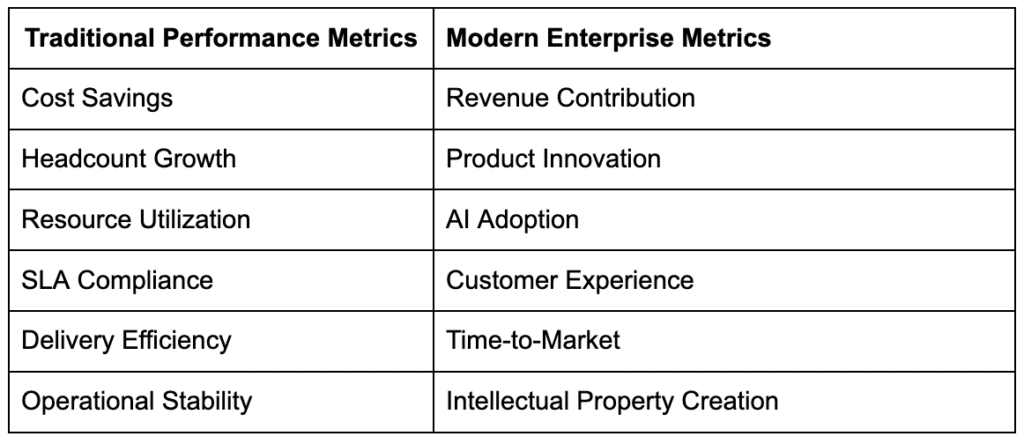
This transition reflects a broader change in enterprise thinking. Instead of asking how efficiently a GCC operates, leadership teams are asking how effectively it accelerates business growth.
Organizations that continue emphasizing cost alone risk optimizing for efficiency while overlooking innovation opportunities that create substantially greater long-term value.
The Five Indicators of a High-Performing GCC
Innovation Velocity
Innovation has become one of the strongest indicators of GCC maturity. Rather than measuring how many projects are completed, organizations are evaluating how many new capabilities originate within the center.
This includes new product features, AI-enabled solutions, engineering accelerators, patents, reusable platforms, and process innovations that improve enterprise performance. A mature GCC is expected not only to execute ideas but also to generate them.
Business Ownership
Leading GCCs are increasingly entrusted with complete business functions instead of isolated technical responsibilities.
Many Indian centers now own global product engineering, cybersecurity operations, cloud modernization programs, enterprise data platforms, and AI Centers of Excellence. This level of ownership demonstrates organizational confidence and reflects the strategic role these centers now play within multinational enterprises.
Ownership has become a far stronger indicator of maturity than organizational size.
AI-Driven Business Impact
Artificial Intelligence is rapidly becoming a core business capability rather than a standalone technology initiative.
Organizations are therefore evaluating how effectively their GCC integrates AI into enterprise operations. Success is measured through productivity improvements, intelligent automation, autonomous workflows, and measurable business outcomes generated through AI-enabled decision-making.
The emphasis is no longer on experimenting with AI but on embedding it into everyday business operations.
Speed of Innovation
Competitive advantage increasingly depends on how quickly organizations can transform ideas into customer value.
Modern GCCs accelerate software releases, shorten product development cycles, automate testing, improve deployment frequency, and reduce engineering bottlenecks across global teams.
Reducing time-to-market has become one of the most valuable contributions a GCC can make to enterprise growth.
Leadership Development
Perhaps the most overlooked measure of GCC success is leadership creation.
India is no longer producing only highly skilled engineers; it is producing global business leaders who manage international product portfolios, lead cross-functional organizations, and influence enterprise strategy.
Organizations that consistently develop global leadership capability from within their GCC build stronger succession pipelines and create long-term organizational resilience.
Why This Shift Matters for Enterprise Leadership
The way organizations measure performance ultimately determines how they invest, reward success, and allocate future resources.
If leadership continues rewarding cost reduction above all else, GCCs will naturally prioritize operational efficiency over experimentation and innovation. Conversely, organizations that recognize business outcomes encourage teams to build new products, adopt emerging technologies, and take greater ownership of strategic initiatives.
This shift in measurement has profound implications for CEOs, CIOs, and CFOs. It changes investment decisions, talent strategies, governance models, and long-term enterprise planning.
The most successful organizations no longer view their GCC as a support function. They view it as one of the company's primary engines of innovation and growth.
Building Outcome-Driven GCCs with Indigrators
At Indigrators, we believe that establishing a GCC is only the first milestone. The real objective is building an organization capable of delivering measurable business outcomes from day one.
Our GCC advisory and Build-Operate-Transfer (BOT) frameworks are designed around modern success metrics rather than legacy operational benchmarks. We help organizations establish capability centers that own products, accelerate AI adoption, develop engineering excellence, strengthen governance, and contribute directly to enterprise growth.
From designing organizational structures and leadership models to building specialized Centers of Excellence and AI-first engineering teams, we enable global enterprises to create GCCs that generate lasting strategic value rather than simply expanding operational capacity.
Conclusion
The evolution of Global Capability Centres has fundamentally changed how enterprise success should be measured.
Headcount, utilization, and cost savings will always remain important operational indicators, but they no longer define the value of a modern GCC. Today's highest-performing centers are distinguished by the products they build, the innovations they deliver, the leaders they develop, and the business outcomes they influence.
For organizations expanding their global footprint in India, adopting this new scorecard is no longer optional, it is essential. The companies that measure innovation, ownership, and enterprise impact will build stronger, more resilient GCCs than those that continue optimizing solely for operational efficiency.
In the coming years, the most important question for every board will not be "How much does our GCC cost?" but "How much enterprise value does it create?"
This question will define the next generation of global capability centers.
From Operational KPIs to Business Outcomes
Ready to build your India team?
Talk to us about GCC setup, software development, or talent solutions.
Get in Touch