
Cybersecurity Cannot Be an Afterthought for AI-Native GCCs — Here’s the Foundation to Build First
In today’s digital economy, Global Capability Centers (GCCs) are no longer just cost-efficient delivery hubs. They’ve evolved into strategic engines of innovation, operational excellence, and competitive advantage for global enterprises—especially mid-sized corporations seeking to scale beyond traditional boundaries. India, with its combination of talent density, cost-effective workforce, and rising innovation ecosystem, stands at the heart of this transformation.
What Are GCCs and Why They Matter Today
Global Capability Centers—also known as Global In-House Centers or Captive Centers—are offshore units fully owned by parent organizations that deliver critical business functions such as IT, analytics, R&D, finance, HR, and product development. Historically, these centers focused on back-office functions and cost arbitrage. But the modern GCC has transformed into a multi-dimensional hub that supports innovation, drives technology adoption, and expands enterprise capabilities globally.
This strategic evolution amplifies value far beyond cost models—enabling faster market responsiveness, deeper customer insights, and scalable global operations.
India’s GCC Landscape: Growth, Depth, and Strategic Value
India’s GCC ecosystem demonstrates both scale and sophistication. According to industry estimates, India hosts over 1,700 GCCs employing nearly 2 million professionals—a number projected to grow significantly by 2030.
Several forces fuel this growth:
1.Talent advantage: India’s deep pool of skilled professionals across technology, analytics, engineering, and domain specialties enables GCCs to shift from routine tasks to higher value creation.
2.Innovation ecosystem: Advanced research clusters, startups, and policy support have fostered an environment where GCCs can build and test new products, deploy AI/automation frameworks, and support global digital transformation.
3.Strategic differentiation: GCCs in India are now essential partners in enterprise digital strategy—driving key initiatives such as advanced analytics, cloud adoption, data engineering, and customer-centric solutions.
This evolution means that GCCs are no longer seen merely as cost centers—they are value creators, co-owners of enterprise digital roadmaps, and hubs for strategic transformation.
Key GCC Trends Impacting Mid-Sized Corporations
From the Inductus whitepaper and broader industry analysis, several trends emerge that are especially relevant for mid-market players:
1. Strategic Shift From Cost to Capability
While cost arbitrage remains attractive, the real competitive edge comes from capability building—connecting GCCs with core business outcomes such as speed-to-market, data-driven decision-making, and innovation cycles.
2. Hybrid Talent and Digital Workforce Models
GCCs are embracing hybrid work models, flexible sourcing, and global digital collaboration—enabling companies to access diverse talent across geographies without compromising quality or agility.
3. Innovation-Led Value Delivery
GCCs are moving up the value chain to work on advanced functions such as R&D, AI integration, product engineering, and cloud modernization—activities once reserved for headquarters.
4. Policy and Ecosystem Support
Government incentives, state-level policies, and ecosystem investments continue to strengthen GCC attractiveness—unlocking infrastructure advantages and reducing friction in setup and scaling.
Together, these trends underscore GCCs as transformational platforms—not just delivery centers.
What This Means for Integrators and Mid-Sized Corporations
For mid-sized enterprises that are navigating growth challenges, GCCs present a strategic blueprint to not only scale operations but also to future-proof business models. Here’s how:
1.Scalable innovation capacity: GCCs can centralize and accelerate experimentation with technology, helping mid-market players compete with larger peers.
2.Operational resilience: Distributed capabilities across geographies reduce single-point dependencies and reinforce continuity planning.
3.Talent leverage: Access to a broad talent pool allows integrators to balance cost, quality, and time-to-value.
4.Global integration: Connected GCCs act as bridges between global markets and local execution engines—driving faster delivery with contextual relevance.
In essence, GCCs empower mid-sized firms to operate with the sophistication and agility of larger global corporations.
Conclusion: GCCs Are Core to Future Growth
The narrative around Global Capability Centers has shifted dramatically—from cost-saving outposts to strategic innovation hubs. India’s GCC ecosystem reflects this shift, offering capacity, capability, and a platform for growth that mid-sized companies can leverage effectively.
In a world where agility and innovation define success, GCCs are no longer an option—they are a strategic imperative for companies looking to scale with insight and resilience.
Source: India’s GCC Landscape: A Strategic Pathway for Mid-Sized Aspirational Corporations to Scale Beyond, Inductus GCC Whitepaper.
A mid-market GCC standing up its first India centre rarely has "build a security operations centre" on its month-one checklist — that instinct is understandable and, increasingly, wrong. As GCCs take on genuinely mission-critical work — AI model development, product engineering, financial operations — the security posture of a 30-person centre matters as much to the parent company’s risk profile as the security posture of headquarters, and retrofitting it after an incident is dramatically more expensive than building it in from the start.
Why the threat surface has genuinely changed, not just grown
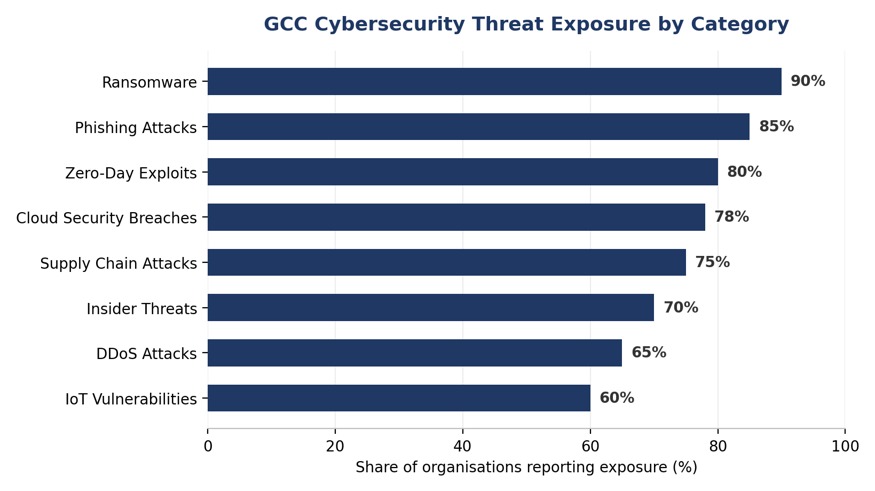
Threat-level data compiled by Inductus Group and cited in Dun & Bradstreet’s 2026 GCC Ecosystem report shows the scale of exposure companies are now navigating: an estimated 90% exposure to ransomware, 85% to phishing attacks, 80% to zero-day exploits, and 78% to cloud security breaches among organisations surveyed, with supply-chain attacks (75%), insider threats (70%), DDoS attacks (65%), and IoT vulnerabilities (60%) rounding out the picture (Dun & Bradstreet, 2026, p. 49, citing Inductus Group). What has changed is not just the volume of these threats but their sophistication. As Lt Gen M Unnikrishnan Nair (retd), Chairman of 63SATS Cybertech and former National Cyber Security Coordinator, Government of India, writes in the same report’s foreword, cyber adversaries are increasingly weaponising AI itself, "ranging from AI-generated phishing campaigns and deepfake impersonation to automated vulnerability exploitation" (Dun & Bradstreet, 2026, p. 9).
GCC Cybersecurity Threat Exposure by Category
Threat Exposure Ranked, with the Foundational Control That Addresses It
| Threat Category | Reported Exposure | Primary Control |
|---|---|---|
| Ransomware | 90% | Immutable backups, endpoint detection & response, tested incident-response playbook |
| Phishing attacks | 85% | Email authentication (DMARC/DKIM/SPF), continuous security awareness training |
| Zero-day exploits | 80% | Virtual patching, network segmentation, continuous vulnerability management |
| Cloud security breaches | 78% | Cloud Security Posture Management (CSPM), least-privilege IAM, encryption at rest/in transit |
| Supply chain attacks | 75% | Vendor risk assessments, software bill of materials (SBOM), code-signing verification |
| Insider threats | 70% | Zero-trust access controls, user behaviour analytics, role-based least privilege |
| DDoS attacks | 65% | CDN/scrubbing services, rate limiting, redundant network architecture |
| IoT vulnerabilities | 60% | Device inventory and segmentation, firmware patching cadence, network isolation |
The specific risk of AI-native GCCs
As GCCs increasingly own AI model development rather than just consuming AI tools, the security conversation has to expand beyond traditional perimeter defence into what Neehar Pathare, MD, CEO & CIO of 63SATS Cybertech, describes as model-centric and data-centric security — protecting the entire AI lifecycle from data ingestion and model training through deployment and autonomous decision-making (Dun & Bradstreet, 2026, p. 12). Pathare names the specific new risks explicitly: data poisoning during training, where compromised datasets distort model behaviour; model manipulation or adversarial attacks designed to influence outputs; model extraction attempts where an outside party tries to replicate proprietary algorithms; and vulnerabilities inherited from third-party models, libraries, and open-source development frameworks used in the AI supply chain (Dun & Bradstreet, 2026, p. 13, Srinivas L, Joint MD & Joint CEO, 63SATS Cybertech).
What "security as architecture, not operational layer" actually means
Pathare frames the goal as building security as an architectural foundation rather than an operational add-on (Dun & Bradstreet, 2026, p. 12) — a distinction that sounds abstract until you translate it into concrete decisions a new GCC has to make in its first ninety days: zero-trust identity frameworks (nobody and nothing is trusted by default, inside or outside the network) rather than perimeter-only defence; unified visibility across cloud and on-premise environments from day one rather than stitching together monitoring tools later; strong, purpose-built protection for data, APIs, and AI workloads specifically, not just generic endpoint security; and the operational capability to detect and respond to threats at machine speed through automation, because a security team relying purely on manual review cannot keep pace with AI-accelerated attacks (Dun & Bradstreet, 2026, p. 12).
The regulatory layer a new GCC cannot skip
Old Framework (Pre-Reform)
- Subjective Margin Audits
- Unpredictable Transfer Tax
- Lengthy Dispute Timelines
VS
Updated Framework (Current)
- 15.5% Safe Harbour Norm
- Clear Value-Chain Status
- Streamlined 24-Month APA
Srinivas L of 63SATS Cybertech notes that evolving data regulations are reshaping cybersecurity requirements for India-based GCCs specifically (Dun & Bradstreet, 2026, p. 13). India’s own Digital Personal Data Protection Act (DPDPA) 2023 sits alongside global frameworks like GDPR and, for companies with California exposure, CCPA — and a GCC handling cross-border data flows for a global parent has to manage compliance across all of them simultaneously, not just the Indian framework. This is driving a broader shift toward data localisation strategies, stronger encryption standards, and stricter access controls, with governance, auditability, and real-time visibility becoming baseline expectations rather than advanced maturity markers (Dun & Bradstreet, 2026, p. 13). Compliance in this environment is not a checkbox exercise — it is a core operating requirement that has to be designed into the centre’s architecture from the outset.
What a lean GCC can realistically do without a dedicated SOC
Not every mid-market GCC can justify building an in-house 24x7 security operations centre in its first year, and it does not need to. What it does need, realistically, from month one: a zero-trust access model applied consistently across the (typically small) initial team, a named security-responsible individual even if that role is fractional, a data classification policy that identifies what data actually flows through the India centre and under which regulatory regime it falls, and a relationship with either the parent company’s existing security function or a specialist managed security partner rather than treating security as something to figure out once the centre has grown large enough to "need" it. The cost of building this properly at 20 people is a fraction of the cost of retrofitting it at 200 people after an incident — and retrofitting after an incident is, in practice, how most under-secured GCCs eventually learn this lesson.
Ready to build your India team?
Talk to us about GCC setup, software development, or talent solutions.
Get in Touch