
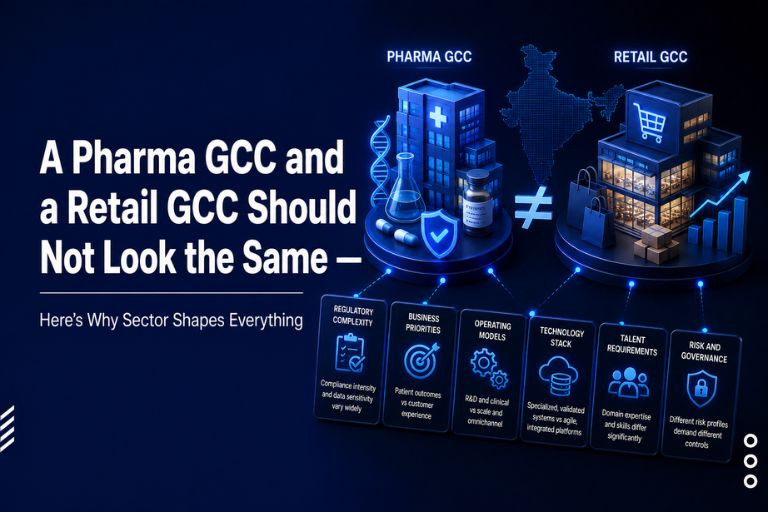
A Pharma GCC and a Retail GCC Should Not Look the Same — Here’s Why Sector Shapes Everything
In today’s digital economy, Global Capability Centers (GCCs) are no longer just cost-efficient delivery hubs. They’ve evolved into strategic engines of innovation, operational excellence, and competitive advantage for global enterprises—especially mid-sized corporations seeking to scale beyond traditional boundaries. India, with its combination of talent density, cost-effective workforce, and rising innovation ecosystem, stands at the heart of this transformation.
What Are GCCs and Why They Matter Today
Global Capability Centers—also known as Global In-House Centers or Captive Centers—are offshore units fully owned by parent organizations that deliver critical business functions such as IT, analytics, R&D, finance, HR, and product development. Historically, these centers focused on back-office functions and cost arbitrage. But the modern GCC has transformed into a multi-dimensional hub that supports innovation, drives technology adoption, and expands enterprise capabilities globally.
This strategic evolution amplifies value far beyond cost models—enabling faster market responsiveness, deeper customer insights, and scalable global operations.
India’s GCC Landscape: Growth, Depth, and Strategic Value
India’s GCC ecosystem demonstrates both scale and sophistication. According to industry estimates, India hosts over 1,700 GCCs employing nearly 2 million professionals—a number projected to grow significantly by 2030.
Several forces fuel this growth:
1.Talent advantage: India’s deep pool of skilled professionals across technology, analytics, engineering, and domain specialties enables GCCs to shift from routine tasks to higher value creation.
2.Innovation ecosystem: Advanced research clusters, startups, and policy support have fostered an environment where GCCs can build and test new products, deploy AI/automation frameworks, and support global digital transformation.
3.Strategic differentiation: GCCs in India are now essential partners in enterprise digital strategy—driving key initiatives such as advanced analytics, cloud adoption, data engineering, and customer-centric solutions.
This evolution means that GCCs are no longer seen merely as cost centers—they are value creators, co-owners of enterprise digital roadmaps, and hubs for strategic transformation.
Key GCC Trends Impacting Mid-Sized Corporations
From the Inductus whitepaper and broader industry analysis, several trends emerge that are especially relevant for mid-market players:
1. Strategic Shift From Cost to Capability
While cost arbitrage remains attractive, the real competitive edge comes from capability building—connecting GCCs with core business outcomes such as speed-to-market, data-driven decision-making, and innovation cycles.
2. Hybrid Talent and Digital Workforce Models
GCCs are embracing hybrid work models, flexible sourcing, and global digital collaboration—enabling companies to access diverse talent across geographies without compromising quality or agility.
3. Innovation-Led Value Delivery
GCCs are moving up the value chain to work on advanced functions such as R&D, AI integration, product engineering, and cloud modernization—activities once reserved for headquarters.
4. Policy and Ecosystem Support
Government incentives, state-level policies, and ecosystem investments continue to strengthen GCC attractiveness—unlocking infrastructure advantages and reducing friction in setup and scaling.
Together, these trends underscore GCCs as transformational platforms—not just delivery centers.
What This Means for Integrators and Mid-Sized Corporations
For mid-sized enterprises that are navigating growth challenges, GCCs present a strategic blueprint to not only scale operations but also to future-proof business models. Here’s how:
1.Scalable innovation capacity: GCCs can centralize and accelerate experimentation with technology, helping mid-market players compete with larger peers.
2.Operational resilience: Distributed capabilities across geographies reduce single-point dependencies and reinforce continuity planning.
3.Talent leverage: Access to a broad talent pool allows integrators to balance cost, quality, and time-to-value.
4.Global integration: Connected GCCs act as bridges between global markets and local execution engines—driving faster delivery with contextual relevance.
In essence, GCCs empower mid-sized firms to operate with the sophistication and agility of larger global corporations.
Conclusion: GCCs Are Core to Future Growth
The narrative around Global Capability Centers has shifted dramatically—from cost-saving outposts to strategic innovation hubs. India’s GCC ecosystem reflects this shift, offering capacity, capability, and a platform for growth that mid-sized companies can leverage effectively.
In a world where agility and innovation define success, GCCs are no longer an option—they are a strategic imperative for companies looking to scale with insight and resilience.
Source: India’s GCC Landscape: A Strategic Pathway for Mid-Sized Aspirational Corporations to Scale Beyond, Inductus GCC Whitepaper.
A common mistake in early-stage GCC planning is designing the centre around a generic "best practice" template rather than around the specific demands of the parent company’s industry. EY’s February 2026 report, "The India Capability Centres Employee Value Proposition Pulse," breaks GCC priorities down by sector (EY, February 2026, p. 4), and the differences are large enough that a template built for a technology company would actively work against a life sciences or energy company trying to attract the same talent pool.
Life sciences, healthcare, and pharma: purpose has to be real, not aspirational
Innovation and a strong organisational purpose or brand are the focal points for this sector, reflecting an industry built around meaningful work and patient impact (EY, February 2026, p. 4). EY’s research shows a maturity pattern here worth noting: as life sciences GCCs mature, organisational brand and purpose rise in EVP priority, while early-stage centres lean more on innovation and internal development (EY, February 2026, p. 4). This sector has also attracted disproportionate capital — GCCs in life sciences and healthcare have drawn over USD 7 billion in FDI, accounting for nearly one-third of total FDI into India’s entire pharmaceutical sector (Dun & Bradstreet, 2026, p. 24). Novartis’s Hyderabad centre illustrates what this looks like at scale: over USD 300 million invested across five years, 9,000 professionals, and a role in actively managing dozens of clinical trials — not an administrative support function but a genuine extension of global drug development (Dun & Bradstreet, 2026, p. 25).
Energy, utilities, and oil & gas: mission has to justify the transformation
These organisations lean on innovation and brand reputation, largely because the industry itself is mid-transformation and needs a compelling reason for talent to join a sector often perceived as legacy or declining (EY, February 2026, p. 4). EY’s data shows a maturity split here too: newer and younger energy-sector organisations emphasise innovation and purpose most heavily, while more mature ones begin to shift weight toward culture and career growth once the initial "why does this matter" question has been answered (EY, February 2026, p. 4).
Technology and engineering: growth has to be visible, not implied
This sector shows the clearest focus on growth opportunities, challenging and creative work, and a collaborative culture — mirroring the nature of the underlying industry (EY, February 2026, p. 4). Innovative work stays central regardless of company age or size in this vertical, but as organisations mature and scale, career progression and compensation gain prominence alongside workplace culture (EY, February 2026, p. 4). The practical implication: a young technology GCC can lean almost entirely on "interesting work" as its pitch, but that pitch has a shelf life, and career-path clarity needs to be built in well before the centre reaches maturity.
Consumer goods and retail: rewards and environment come first, culture catches up later
Retail and consumer goods organisations heavily emphasise rewards and a positive work environment to attract and retain talent, particularly at the early stage (EY, February 2026, p. 4). As organisations grow older and larger, focus shifts toward workplace culture, compensation, and career progression, while early-stage or small organisations in this sector lean hardest on innovation and brand (EY, February 2026, p. 4). Lowe’s Bengaluru centre is a useful proof point of what a mature retail GCC can deliver: a proprietary self-checkout system built in-house, now handling 40–50% of transactions (up from 25%) and rolled out across more than 1,700 US stores — built at a fraction of vendor cost and demonstrating that a retail GCC can be a genuine profit accelerator, not just a cost centre (Dun & Bradstreet, 2026, p. 24).
BFSI, ER&D, and business services: two more patterns worth naming
Business services capabilities — particularly those touching HR or broader organisational reputation — see purpose and career progression rise in importance, since employee intent and mission tend to matter more when the function itself is people-facing (EY, February 2026, p. 3). Engineering R&D (ER&D) capabilities show a strong, consistent emphasis on work environment, innovative work, and organisational brand — the profile most likely to determine whether a centre can attract genuinely top-tier engineering talent rather than settling for adequate talent (EY, February 2026, p. 3). ER&D alone now contributes an estimated USD 34+ billion to India’s total GCC market, and Karnataka in particular is positioning itself for deeper policy focus in this specific capability (Dun & Bradstreet, 2026, p. 43).
What Each Sector Leads With — and a Proof Point
| Sector | Top EVP Priorities | Proof Point |
|---|---|---|
| Life sciences, healthcare, pharma | Innovation, organisational purpose/brand (brand rises further with maturity) | Novartis Hyderabad: 9,000 professionals, 52 clinical trials across 335 sites |
| Energy, utilities, oil & gas | Innovation and brand reputation, especially in younger centres | Sector-wide transformation narrative used to justify the mission story |
| Technology & engineering | Growth opportunities, creative work, collaborative culture | Innovative work stays central regardless of company age or size |
| Consumer goods & retail | Rewards and work environment early; culture and career progression as centres mature | Lowe’s Bengaluru: self-checkout system across 1,700+ US stores |
| Business services (HR, finance) | Purpose and career progression | Employee intent/mission is central to HR-driven GCCs |
| Engineering R&D (ER&D) | Work environment, innovative work, organisational brand | ER&D contributes an estimated USD 34+ Bn to India’s GCC market |
Old Framework (Pre-Reform)
- Subjective Margin Audits
- Unpredictable Transfer Tax
- Lengthy Dispute Timelines
VS
Updated Framework (Current)
- 15.5% Safe Harbour Norm
- Clear Value-Chain Status
- Streamlined 24-Month APA
The design implication for a new GCC
None of this means every GCC needs a bespoke, from-scratch EVP framework — the underlying levers (innovative work, career progression, purpose, rewards, environment, brand, recognition) are the same seven across every sector EY studied (EY, February 2026, p. 5). What changes is the weighting and the sequencing: which two or three of those seven levers to lead with in a job posting, and which to layer in as the centre matures. Getting that weighting wrong — leading a pharma GCC’s hiring pitch with compensation instead of purpose, or leading a retail GCC’s pitch with abstract mission instead of concrete rewards — is a solvable problem, but only if the sector-specific pattern is deliberately designed for rather than defaulted to.
Ready to build your India team?
Talk to us about GCC setup, software development, or talent solutions.
Get in Touch